Longjing Tea Grades Explained: Ming Qian vs Yu Qian Timing
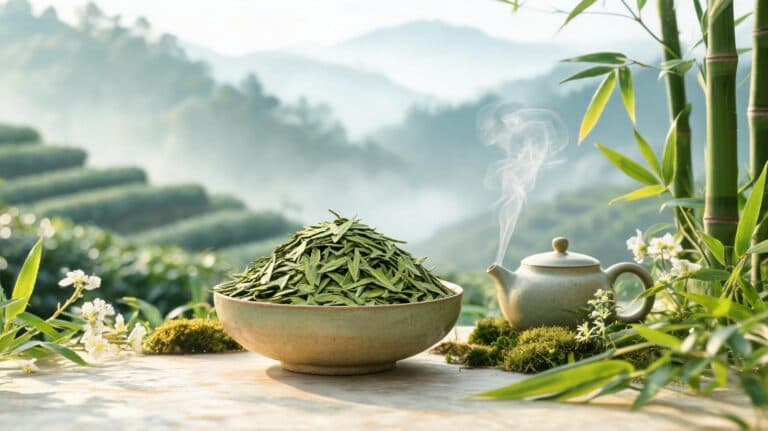
The tea farmer dropped a pinch of pale, flat leaves into a glass and poured water at 85°C. “This is Ming Qian,” he said. “It costs $95 per 100g. The one picked two weeks later, Yu Qian, costs $35.” I asked which one he drinks at home. He laughed and pointed at the cheaper bag.
That moment explains longjing tea grades better than any grading chart. The early harvest is a luxury. The later one is often the better daily cup. Timing matters more than the label a seller puts on the bag.
What Are Longjing Tea Grades, Really?
Longjing tea grades are harvest-date categories, not a quality score out of ten. The two main splits are Ming Qian, meaning picked before Qingming around April 5, and Yu Qian, meaning before Guyu around April 20.
Sellers sometimes add terms like “first flush” or “AAAA Superfine.” Most of that is inconsistent. A 2023 Chinese government standard uses grades from Superfine to Grade 4, but those don’t always track flavor. I trust the date and the origin more.
Longjing tea grades in practice look like this:
- Ming Qian: picked before April 5, costs $80 to $200 per 100g
- Yu Qian: picked before April 20, costs $30 to $70 per 100g
- Late April onward: usually ungraded, works for cold brew
If you see a seller list only “longjing tea grade A,” ask for the picking date. That tells you more than the letter.
Ming Qian Longjing
Ming Qian Longjing means the leaves came off the bush before the first week of April. The buds are tiny and tender. A farmer may pick only 400 grams of fresh leaf in a morning. The resulting tea tastes sweet and soft, with a light floral edge. I sip it slowly. It fades after four infusions, which is fine for a quiet cup.
Yu Qian Longjing
Yu Qian Longjing tea arrives before April 20. Leaves are larger and have more heft. The brew is nuttier, with a roasted chestnut edge. It gives five to six infusions. This is what I buy for daily drinking.
Why Does Ming Qian Cost So Much?
Ming Qian costs more because the picking window lasts only about seven to ten days. After that, the buds grow too big and the leaves lose their tenderness. The yield is tiny compared to the later harvest.
In 2024, core West Lake Ming Qian sold for $120 to $200 per 100g. Yu Qian from the same villages ran $30 to $70. That’s a three-fold jump for roughly two weeks of difference.
A Ming Qian grade label only tells you the plucking date, not that the tea will suit your taste.
How Do Ming Qian and Yu Qian Taste Different?
Ming Qian tastes sweeter and lighter, while Yu Qian has more roasted chestnut depth and a longer finish.
My first steep of Ming Qian at 85°C for 2 minutes gives steamed edamame and a trace of orchid. By the third steep, it’s barely there. Yu Qian at 90°C for 3 minutes gives roasted grain and a buttery aftertaste that sits on the tongue. Honestly, I prefer the second.
Some years, a rainy spring makes Ming Qian taste flat and a dry spring makes Yu Qian unusually sweet. Harvest weather changes character more than the grade name.
Freshness beats grade every time. A fresh Yu Qian from this spring will beat a Ming Qian that sat on a shelf for 18 months.
Are Longjing Tea Grades Worth Paying For?
For most daily drinkers, a good Yu Qian beats a mediocre Ming Qian every time.
The trouble is that labels drift. A $30 “Ming Qian” from an unknown online shop may be from Sichuan or picked in late April and relabeled. Grade names don’t verify anything by themselves. If you trust the farmer or the shop, early harvest is worth trying once. If you have less than $50 per 100g to spend, go for Yu Qian from a known origin.
The simplest way to choose a Longjing grade is to ask two questions: what was the picking date, and where was it grown? Spend on the harvest date and the source, not on a grade label that says “Superfine.”
I keep a small tin of Ming Qian for guests and quiet mornings. For the other 300 days, I drink Yu Qian.
How Should You Brew Longjing Once You Know the Grade?
Brew Ming Qian with 85°C water for 2 minutes in a glass cup; use 90°C and 3 minutes for Yu Qian.
I use 2 grams of leaf per 200ml of water. Drop the leaves in first, then pour water down the side of the glass so the leaves don’t scald. You can watch them float, then slowly sink. The first aroma at 70°C is the best part.
If you only have a mug at the office, lower the leaf to 1.5 grams and steep for 2 minutes. The flat leaves need room to release their flavor.
Don’t use boiling water. 100°C water turns Ming Qian bitter fast. I learned that the hard way.
Last spring I brewed a 2023 Yu Qian next to a 2024 Ming Qian without looking at the bags. The Yu Qian won. The reason was freshness, not a higher grade. I used water at 90°C. I still bought a small tin of Ming Qian for the pleasure of it. But the daily pot is Yu Qian. The Yu Qian from Hou Tea’s spring shipment was $42 per 100g, and it held up for six infusions.
Not sure which Longjing grade fits your taste? Take our Five Elements quiz or ask our AI Tea Doctor. It takes 30 seconds and gives you a personalized pick.