How to Buy Real Longjing Tea Online (Without Getting Fooled)
How Is Real West Lake Longjing Different from Fake Tea Sold Online?
Real West Lake Longjing comes from a strictly protected 168 km² area, with core villages under 15 km² producing only 500–600 metric tons a year. Meanwhile, the web sells “Longjing” by the thousands of tons. You see the math.
The rest is Longjing-style tea from other provinces—Zhejiang outside the protected zone, Sichuan, Guizhou, even Shandong. These are not necessarily bad teas; some are pleasant daily drinkers. But they’re not Dragon Well. The difference is texture and longevity in the cup. A real West Lake tea will give you 5 infusions with evolving nuttiness. An imitation might taste fine for one steep, then fall flat into vegetal nothingness. You’re paying for that staying power.
When I first tried buying Longjing online years ago, I thought all Longjing tasted grassy. I was drinking cheap tea from a well-reviewed shop. Only after a trip to Hangzhou did I understand the real thing: toasted chestnuts and faint orchid—not grass clippings.
How to Spot Authentic Longjing Tea Before You Buy?
You can rule out 90% of fake Longjing before buying by checking price, leaf shape, and seller transparency. Genuine rarely sells under $0.80/gram; the leaves should be flat and sword-like; and the seller must name the village.
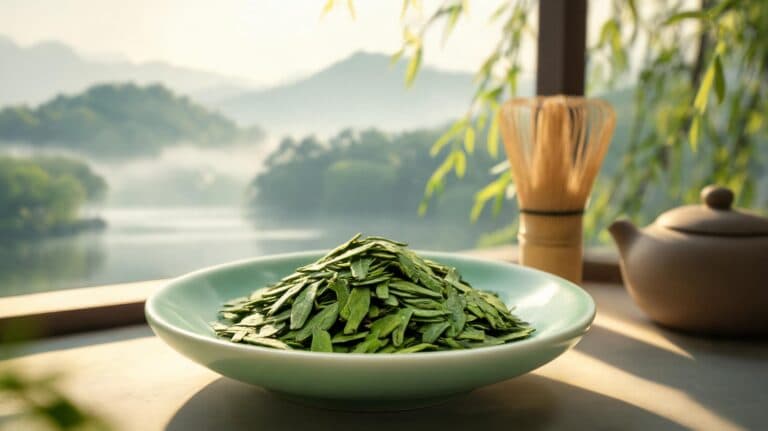
Real West Lake Longjing is flat and sword-like—not twisted or curly—thanks to skilled pan-firing that takes years to learn. The leaves should be uniform yellowish-green with a slight downy fuzz, and free of stems or broken bits. Bright spinach-green leaves often signal over-roasting to mask inferior leaf.
Dry leaf fragrance, called tixiang, is nutty—like soy milk skin. A grassy or seaweed scent means it’s probably not from West Lake. Until your nose knows the real thing, rely on that flat shape and a price sanity check as your quickest filters.
One more thing: a listing that claims “West Lake” but only says “Hangzhou” is dodging the truth. Ask the seller to name the village—Longwu, Meijiawu, or Shi Fengshan. If they can’t, move on.
What’s the Minimum Price for Real West Lake Longjing?
As of 2024, genuine West Lake Longjing rarely sells under $0.80 per gram; top early-spring Ming Qian can run $1.50–$3 per gram. A 100g bag priced at $29 online is almost certainly Sichuan tea in a pretty tin.
Late-spring picks, harvested after the early April rush, still carry West Lake character but cost half as much. They’re less delicate, more nutty, less floral. I often buy those for daily drinking—I’d rather have a real Longjing with a bit less perfume than a fake.
Beware “blends.” Some shops offer a “West Lake Longjing Blend” at a low price—the fine print might reveal it’s only 10% genuine mixed with off-zone leaf. A 2021 China Tea Marketing Association report found the average wholesale price for genuine West Lake Longjing was 1,200 CNY/kg (~$170/kg), so any retail price far below that raises questions. If a listing doesn’t say 100% single-origin, assume it’s a blend.
What Should You Look For When You Actually Brew It?
Brew at 80°C in a tall glass, no strainer. Real Longjing yields a clear pale yellow-green liquor; leaves descend slowly, some standing upright. I use 2.5g to 150ml water. Fakes sink fast and look lifeless.
Taste: roasted chestnut, a sweetness that builds, and no bitterness for at least three infusions. Fake Longjing turns grassy and astringent by the second steep. The real aftertaste is buttery and lingers.
I once saw a friend pour boiling water on a beautiful $80 tin of “Longjing” she’d ordered online—the liquor turned cloudy brown in seconds. The tea was over-roasted to mimic a nutty scent. That’s why I always recommend a 25g sample first. Trustworthy sellers who offer authentic Longjing provide samples because quality speaks for itself.
Where to Buy Real Longjing Tea Online?
The safest route is to buy from a shop that sources directly from a named West Lake village, specifying harvest date and producer. Avoid large marketplaces where listings aggregate from multiple unknown suppliers—that’s where counterfeiting blooms. Look for small-scale importers who travel to China every spring, visit the farms, and cup the tea themselves. Their prices are often not much higher than blends, because they cut out middlemen.
If you’re still hedging, start with a sample from a seller that lists the producer’s name and the village. At Hou Tea, we buy only from a single family cooperative in Longwu, so every spring I know our Longjing came from the same camellia sinensis bushes, not an anonymous auction lot. If that traceability appeals, take a look. But wherever you buy, ask pointed questions. If the seller can’t name the village, keep your money.
Negotiating the world of longjing tea buy online isn’t about hunting for a crazy deal. It’s about trusting someone who knows the product personally. Tea is agricultural, seasonal, and subjective—same as wine. You wouldn’t buy a bottle of Burgundy from a site with a stock photo and a generic description. Don’t do it with Longjing either.
One last thought. The best Longjing I ever tasted was a tiny 15g packet a farmer’s wife handed me on a drizzly morning in Meijiawu in 2019. She’d fired it two days earlier in a wok behind her house. You can’t buy that online. But you can get close—closer than the mass-produced tins at the top of search results. Start small, taste consciously, and let your palate build a memory for what authentic Dragon Well actually feels like. Once you have that, the fakes become obvious before you even take a sip.
Not sure which tea is right for you? Take our Five Elements quiz or ask our AI Tea Doctor — it takes 30 seconds and gives you a personalized pick. If you want to taste the Longjing I write about, our spring selection comes fresh from a single village every year.