Da Hong Pao Tea: Why This Cliff Oolong Is So Famous
What is da hong pao tea, exactly?
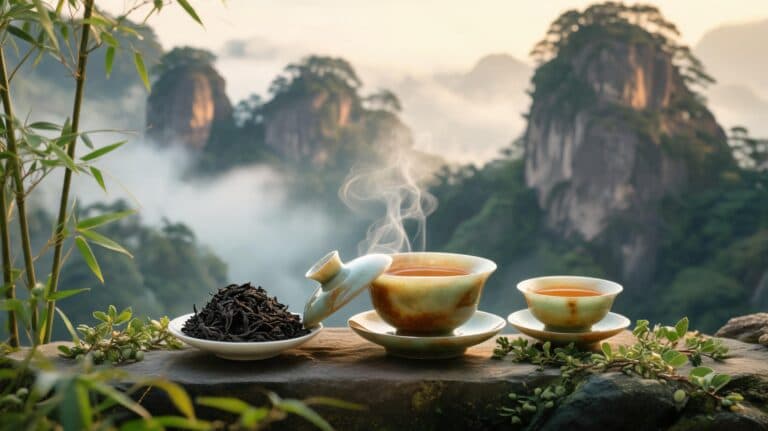
At 6 a.m. in the Wuyi Mountains, the rock faces hold last night’s cool air, and the tea bushes growing in narrow crevices smell faintly mineral even before the sun hits them.
Da hong pao tea is a famous Wuyi rock oolong from Fujian, known for a roasted, mineral style and a story that became bigger than the tea itself.
If you’ve heard it called the “king of oolong” or searched for the original Da Hong Pao tea, you’ve already run into the myth. The name means “Big Red Robe,” and the oldest story says an official draped red robes over the mother bushes after the tea helped cure an illness. I’ve heard a few versions in Wuyishan. The details shift. The point doesn’t: this tea became famous because people believed it was exceptional, then generations of tea makers kept proving it could be.
Da Hong Pao is best understood as a Wuyi yancha, or rock tea, before it is understood as a legend.
That matters because most Da Hong Pao sold today is not picked from the original mother bushes. Those bushes are protected, and commercial harvest from them stopped years ago. What you drink now is usually made from cultivated bushes, often blended from Wuyi cultivars like Rou Gui or Shui Xian to match the classic Da Hong Pao profile. Some tea sellers are very direct about this. Some are not.
And honestly, that’s fine. In my experience, a good modern Da Hong Pao can still be deeply satisfying. You’re buying style and skill, not a museum relic.
Why is da hong pao tea so famous?
Da hong pao tea is famous because it combines a powerful origin story with a flavor that feels unmistakably tied to place.
The place is the Wuyi Mountains in northern Fujian, a UNESCO-listed area known for rocky terrain, mist, and old tea routes. Tea farmers there talk a lot about yan yun, often translated as “rock rhyme.” It’s that dry, cooling, mineral aftertaste you get in a proper Wuyi oolong. Hard to fake. Easy to remember.
There’s also the rarity factor. In the early 2000s, tea made from the original bushes was reported at auction for enormous prices, with headlines throwing around numbers well above $10,000 per 20 grams. That kind of number turns any tea into a legend overnight. But the better reason for its reputation is simpler: when Da Hong Pao is made well, it has real depth.
I think this is why so many people get hooked on it after one serious session. Not the first sip, necessarily. The third or fourth steep. That’s when the roast settles down and you start tasting toasted grain, dark orchid, maybe a cocoa note, then that stony finish that sits at the back of your throat for a minute or two.
A good Wuyi rock tea often tastes more mineral and roasted than fruity, and that is exactly why many drinkers love it.
What does Da Hong Pao taste like?
Da Hong Pao tastes roasted, mineral, woody, and floral, with less bright sweetness than many Taiwanese oolongs.
This is where people get surprised. They expect something soft and perfumed because it’s famous. But classic Wuyi rock oolong flavor has structure. The first sip can feel like roasted chestnut or baked grain. Then you might get orchid, dry cacao, sandalwood, even a faint char if the roast is fresh. Better versions have a returning sweetness after you swallow.
Lower-grade tea can taste flat, smoky, or harsh. That usually means one of two things: rough leaf material or a roast that covers flaws instead of shaping the tea. Price tells you something here. Decent everyday Da Hong Pao often lands around $18 to $35 per 100g. More carefully made tea from better Wuyi material can run $35 to $60 per 100g, sometimes higher.
I tend to prefer medium-roast examples. Heavy roast can be wonderful in winter, especially after resting a few months, but too much fire can blur the cliff character. And cliff character is the whole reason to drink this tea.
How do you brew da hong pao tea for the best flavor?
Da hong pao tea brews best with near-boiling water, a high leaf ratio, and short steeps that let the roast and mineral notes open gradually.
For gongfu brewing, I use 7 to 8 grams in a 100ml gaiwan or small pot, water at 95°C to 100°C, and a quick rinse of about 5 seconds. First steep: 10 seconds. Second: 12 seconds. Then add a few seconds each round. Good tea will give you 6 to 8 satisfying infusions, sometimes more.
Western style works too, just different. Try 3 grams in 250ml water at 95°C for about 2 minutes, then adjust. Shorter if it gets too woody. Longer if the cup feels thin.
Near-boiling water is usually better for Da Hong Pao than 85°C water because Wuyi oolongs need heat to release their roast and mineral depth.
One practical note: let freshly roasted tea rest. I like waiting at least 2 to 4 weeks after roast before judging it. Right after roasting, the aroma can feel loud and the body a bit closed. Give it time and the tea settles into itself.
Is all Da Hong Pao made from the original cliff bushes?
No, almost all Da Hong Pao on the market is made from cultivated tea plants, not the original mother bushes.
This is the part that confuses people, and I don’t blame them. Sellers use the name in a few ways. Sometimes it means tea from a specific cultivar line linked to Da Hong Pao. Sometimes it means a blend crafted in the Da Hong Pao style. Sometimes it just means roasted Wuyi oolong with a familiar label.
That doesn’t automatically mean you’re being misled. Tea names in China often carry both botanical and stylistic meaning. But you should read closely. Terms like mother bush Da Hong Pao are mostly for storytelling unless the seller is dealing in tiny, rare, documented quantities, and those are not normal retail teas.
I’d rather buy an honest blend from a skilled Wuyi producer than an inflated “legend tea” with vague sourcing. Taste wins.
Why do serious tea drinkers keep coming back to it?
Serious tea drinkers come back to Da Hong Pao because it changes in the cup and rewards attention without being fussy.
That’s the real charm. You can drink it casually on a rainy afternoon and just enjoy the warmth. Or you can sit with it for 40 minutes and track how the roast softens, how the throat feel gets cooler, how the empty cup smells sweeter than the liquor itself. Few teas do that so clearly.
It also ages in an interesting way. Rested roast can turn deeper and smoother over 1 to 3 years if stored well, sealed and away from light or kitchen smells. Not every batch improves, but some do.
My own test is simple. After the fourth steep, does the tea still have energy? Not caffeine, exactly. Presence. A good Da Hong Pao still feels alive there, with that rocky grip and a lingering sweetness that makes you want one more pour.
If you want to try that style for yourself, start with an honest Wuyi oolong from a seller who tells you the roast level and harvest season. And if you’re not sure where to start, Hou Tea’s AI Tea Doctor can point you toward a roast level that fits your taste instead of just handing you the most famous name.
Not sure which tea is right for you? Take our Five Elements quiz or ask our AI Tea Doctor — it takes 30 seconds and gives you a personalized pick.