Chinese Tea Gift Guide: Picks for Lovers, Newbies, Health Nuts
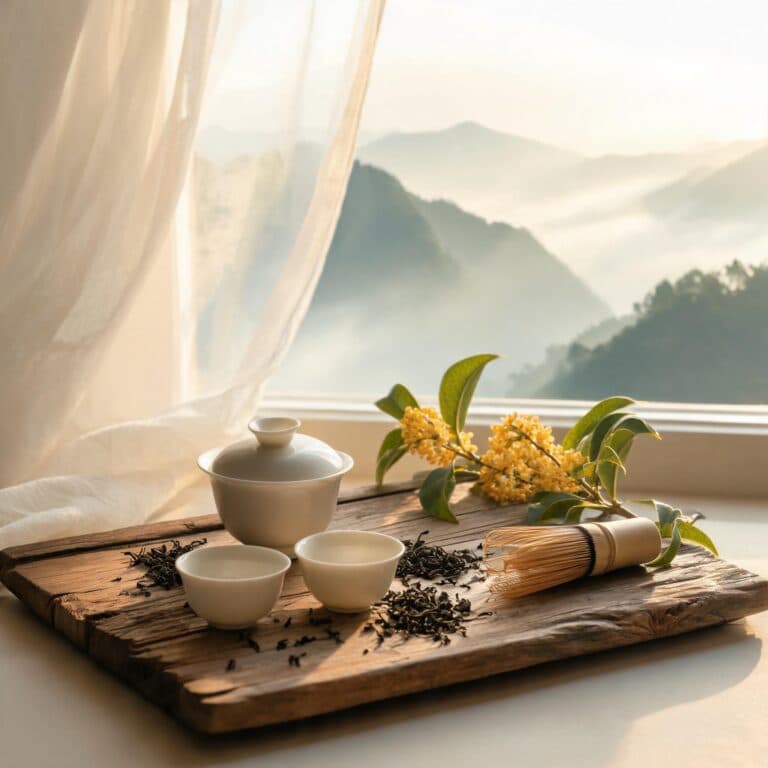
Last December, I handed my brother—a die-hard coffee drinker—a 50g pouch of Tie Guan Yin. He stared at the twisted leaves like I’d given him a science experiment. Two months later, he texted me asking where to buy more.
Gifting Chinese tea is weird like that. Most people think it’s intimidating, or maybe too subtle. But the right tea, handed to the right person, does something coffee can’t. So I put together this Chinese tea gift guide after years of giving and receiving tea that people actually drank. It’s my answer to the ‘what’s the best Chinese tea to give as a gift?’ panic.
What’s the Best Chinese Tea Gift for a Hardcore Tea Lover?
Something they wouldn’t buy for themselves.
A serious drinker already has a daily go-to—a daily drinker Tie Guan Yin or a reliable Yunnan black. Their shelf is full. The gift that actually excites them is a rarity: a single-origin cake that will age, or a high-mountain oolong from a specific harvest. These aren’t souvenirs. They’re stories that unfold in the cup.
A 2021 Spring Yiwu raw pu-erh cake costs $60–$90 for a 200g disc and will age for decades into date sweetness and forest floor depth. Right now, it’s bright and astringent, with green apricot and a cooling camphor finish. But tucked away for five or ten years, it transforms—the kind of gift that keeps giving. If they’re more into oolong, a 2023 Lishan (Pear Mountain) high-mountain oolong from Taiwan runs $40–$60 for 150g. The liquor is creamy, almost buttery, with a floral aftertaste that mass-market versions never touch. You’re not giving a tea; you’re giving a specific mountain, a single season.
For someone who already owns a gaiwan and a scale, this is the only kind of present that makes their heart beat a little faster. No pretty gift box needed.
What Chinese Tea Should I Get Someone Who’s Never Tried Loose Leaf?
A tea that forgives sloppy brewing.
The worst gift for a newbie is something precious that turns bitter the moment they forget the timer. You want their first loose-leaf moment to feel easy, not like a chemistry exam. Long Jing (Dragon Well) is my #1 pick. Its leaves are pan-roasted until they taste nutty and sweet—zero astringency if you use 175°F water and a 2-minute steep. But even if your friend boils the kettle, dumps it in, and walks away, Long Jing just goes a little flat. It won’t punish them. A 50g tin of authentic West Lake Long Jing costs $25–$40 and looks elegant without trying too hard.
The other can’t-mess-it-up option is Dian Hong, a Yunnan black tea full of fuzzy gold buds. Dian Hong black tea from Yunnan is practically un-ruinable—it turns into malt-honey liquid no matter how long you steep it. $15–$25 buys 100g, and the flavor is nothing like a teabag: dried longan, cocoa, a faint whiff of sweet potato. It handles boiling water with zero bitterness. No timer needed. Chinese tea gifts for beginners don’t require a gongfu set. A simple infuser basket and forgiving leaves are all you need. And that’s the heart of this Chinese tea gift guide: a tea that forgives.
Which Chinese Tea Is Actually Good for Your Health?
White tea and ripe pu-erh, hands down.
If you’re hunting for a healthy Chinese tea gift, skip the detox blends and reach for pure white tea. The minimal processing—just withering and drying—preserves more antioxidants than any other style. White tea retains more catechins than green tea, making it the highest-antioxidant tea, per a 2017 Journal of Food Science analysis. I always pick bai mu dan (White Peony) as a gift because it’s affordable ($18–$30 for 100g) and forgiving. The leaves are a mix of silvery buds and larger green leaves, so the brew is light and slightly floral, with a hint of melon. Cold-brew it overnight and it tastes like summer. Your health-conscious friend doesn’t need a ceremony—a glass and hot water is enough.
Ripe pu-erh is the other one I hand to anyone who talks about cholesterol or gut health. Ripe pu-erh’s microbial fermentation produces statin-like compounds that lower LDL cholesterol, as shown in a 2015 Chinese Journal of Integrative Medicine study. It’s earthy, smooth, and almost coffee-dark, but with minimal caffeine. A 250g brick from Menghai costs $25–$40 and can be steeped a dozen times. I usually tell people to rinse it once with boiling water, then steep for 30 seconds. The second steep is where the magic happens—forest floor, petrichor, a little sweetness. If this Chinese tea gift guide has one rule for health teas, it’s: processing trumps hype. Your yoga friend doesn’t need a ‘detox’ blend. They need actual leaves.
So that’s the Chinese tea gift guide in three categories: a rarity for the obsessive, a forgiving tea for the first-timer, and honest health tea for the wellness friend. Last I checked, my brother had three different oolongs lined up on his desk. The coffee machine’s been in the cabinet for weeks. I’m not saying the Tie Guan Yin converted him. But I’m not not saying that.
Still unsure which tea fits your gift recipient? Take our Five Elements quiz or let the AI Tea Doctor match their taste and vibe in under a minute—it knows the difference between a Tie Guan Yin person and a Dian Hong person.