Chinese Tea Ceremony for Beginners: Start Gongfu Cha
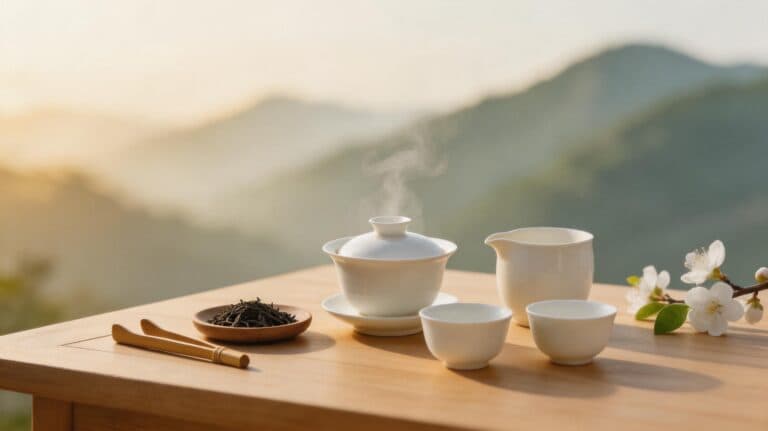
What is a chinese tea ceremony for beginners?
The chinese tea ceremony beginners actually need is just gongfu cha, a simple way of brewing loose leaf tea in small vessels with short steeps and full attention.
The first time I watched gongfu cha on a tea table in Fujian, the host poured 95°C water over a tiny gaiwan, warmed the cups, then brewed oolong for about 20 seconds. Nobody was performing. Nobody was whispering ancient secrets. It felt practical, calm, and very human.
That is the part people often miss. A beginner-friendly chinese tea ceremony is not about memorizing rules. It is about using a little more leaf, a little less water, and repeating short infusions so you can taste how the tea changes.
Gongfu cha means “brewing with skill,” but for a beginner it mostly means paying attention for 15 to 30 seconds at a time.
In my experience, the intimidating version mostly lives online. Real tea people will usually hand you a cup and say, “Try this one.”
Do you need special tools for a chinese tea ceremony?
No, you only need loose leaf tea, hot water, and one small brewing vessel to start a chinese tea ceremony at home.
A full tea tray setup can be lovely. It can also cost $80 to $200, which is a silly barrier if you are just trying to learn. You can begin with a 100 ml gaiwan, a fairness pitcher if you want easier pouring, and 2 small cups. A basic porcelain gaiwan often costs $10 to $20. That is enough.
If gaiwans make you nervous, use a small teapot. I still think a gaiwan teaches faster because you can smell the lid and watch the leaves open. But a teapot is forgiving.
- Best starter vessel: 90 to 120 ml porcelain gaiwan
- Best tea for practice: oolong, black tea, or shou pu-erh
- Water temperature: 90°C for green tea, 95°C to 100°C for oolong and pu-erh
- Leaf ratio: about 5 grams per 100 ml
You do not need a tea pet, a bamboo scoop, or a collector’s kettle to practice gongfu tea ceremony basics.
I would skip green tea for your first session unless you already love it. Green tea is easier to overbrew in a small vessel, and beginners often mistake that sharpness for failure.
How do you do gongfu cha step by step without feeling awkward?
You do gongfu cha by warming the vessel, adding tea, making short infusions, and pouring every steep fully so the leaves stay balanced.
Here is the version I teach friends at my kitchen table.
1. Warm everything
Pour hot water into the gaiwan and cups. Swirl for 5 seconds. Dump it out. This raises the temperature and gets your hands used to the motion.
2. Add the tea
Use 5 grams of loose leaf for a 100 ml gaiwan. Rolled oolong looks like too little at first. Then it expands like crazy.
3. Wake the leaves, if the tea suits it
For oolong, black tea, or pu-erh, you can do a quick rinse of 3 to 5 seconds. I usually skip rinsing delicate green tea.
4. Brew the first steep short
Start around 15 to 20 seconds for oolong, 10 to 15 seconds for black tea, and 10 seconds for shou pu-erh. Pour it all out right away.
5. Extend gradually
Add 5 to 10 seconds each round. A good yancha might give you 6 infusions. A solid shou can go 8 or more.
6. Taste the change
The first cup may smell floral or roasted. By the third steep, sweetness often shows up. By the fifth, texture matters more than aroma.
The one mistake that ruins most beginner gongfu sessions is leaving even 10 ml of tea in the gaiwan, because that leftover liquid keeps extracting and turns the next cup bitter.
And yes, you will spill a little at first. Everybody does.
Which tea is best for a beginner chinese tea ceremony?
The best tea for a beginner chinese tea ceremony is a forgiving oolong, especially a roasted Tieguanyin or a mellow Wuyi rock tea.
Why oolong? It gives you movement from steep to steep. You can taste something happen. A green tea can be lovely but subtle. A young sheng pu-erh can be thrilling but also aggressive. Good beginner oolong has room for mistakes.
I often pour new drinkers a medium-roast oolong because the flavor is easy to recognize: toasted nuts, warm grain, maybe orchid if the tea is higher grown. It feels generous. And at $18 to $35 per 100 grams, there are plenty of good options that do not feel like collector tea.
- Easiest start: roasted oolong
- Comforting choice: shou pu-erh
- For black tea drinkers: Chinese black tea like Dianhong
- Harder first pick: delicate green tea, young sheng pu-erh
For most people, the best tea for gongfu cha at home is one that tastes good even when your timing is off by 10 seconds.
If you want to try a good oolong or explore pu-erh tea, start there rather than chasing rare names.
Is the chinese tea ceremony about rules or about attention?
The chinese tea ceremony is more about attention than rules, especially in everyday gongfu cha.
There is history here, of course. Different regions do things differently. Chaozhou style can feel sharper and faster. Taiwanese tea tables often look a bit more polished. Family habits matter too. But in practice, most sessions are built around care, not perfection.
I think beginners get stuck because they assume they are entering a formal system where every gesture must be correct. That fear makes people stiff. Tea tastes worse when you are busy performing.
So I would borrow the useful parts. Warm the cups. Pour with intention. Notice the aroma on the lid. Keep your phone face down for 10 minutes. That alone changes the experience.
A 2021 study in Frontiers in Psychology found that short mindful rituals can improve present-moment attention, and gongfu cha works exactly like that for a lot of people. Not because it is mystical. Because it asks you to stay with one small thing.
The real beginner lesson of the chinese tea ceremony is that precision helps, but presence matters more.
Some of my best sessions were messy ones, with a chipped cup, steam on the window, and one tea that kept tasting like roast chestnut for 7 steeps.
Want help picking a tea for your first gongfu session? Take our Five Elements quiz or ask our AI Tea Doctor — it takes 30 seconds and gives you a personalized pick.