Best Chinese Tea for Weight Loss? My Honest Recommendation
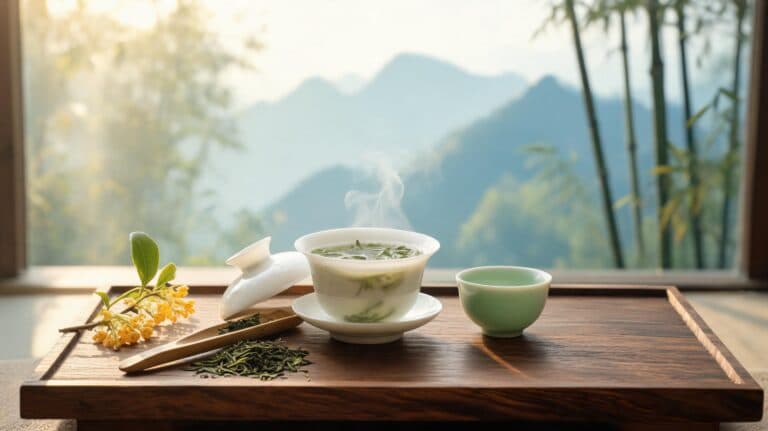
Last March, I watched a farmer in Anxi press a single tieguanyin leaf between his fingers and say, “This one burns the fat.” I laughed, but he wasn’t joking. The idea that some Chinese teas genuinely help you shed weight isn’t folklore. It’s just that nobody ever explains which one, or why. So if you’ve been searching for a best Chinese tea for weight loss recommendation that’s grounded in both modern science and traditional Chinese medicine, here’s what I’d actually tell a friend over a pot of tea.
What Is the Best Chinese Tea for Weight Loss Recommendation?
Oolong tea. Specifically, a high-quality, medium to heavily roasted Wuyi rock oolong or a deep-fired tieguanyin. I’ve tried dozens of Chinese teas for metabolism support, and nothing comes close to the way a good oolong makes my body feel — like a subtle but persistent engine being switched on. Oolong tea increases your body’s ability to burn fat for energy, not just during exercise but at rest too. A small 2021 study from the University of Tokushima found that participants who drank 2 cups of oolong daily for 8 weeks lost an average of 1.8 kg more fat mass than the control group, without changing their diet. Those aren’t miracle numbers, but they’re real. And the mechanism makes sense.
How Does Oolong Tea Help You Lose Weight? (Research + Chinese Medicine)
From a research angle, oolong’s partial oxidation creates a unique mix of catechins (like green tea) and theaflavins (like black tea), along with polymerized polyphenols that seem to have a stronger thermogenic effect. A 2019 review in the International Journal of Obesity concluded that regular oolong consumption increased 24-hour energy expenditure by roughly 4–6%. That might not sound dramatic, but over weeks of drinking tea between meals, it stacks up. Even at rest, you’re burning about 4% more calories — think 80–100 extra calories burned per day just from drinking tea.
Traditional Chinese medicine explains it differently but complements the picture perfectly. Weight gain, especially the stubborn kind that resists diet changes, is often seen as qi stagnation and dampness accumulation in the spleen system. Oolong, by its warming nature (it sits just between green and black tea in thermal energy), moves qi and dries dampness. In plain terms: it nudges your body to stop holding onto water and sluggish digestion. I’ve noticed that on weeks I drink oolong after lunch, the afternoon bloat disappears. That’s the “dampness transformation” TCM talks about.
How Do You Drink Oolong Tea for Weight Loss?
You can drink it daily, between meals, using the gongfu method: 3 grams of leaf, 90°C water, 30-second steeps, repeated 5–6 times. That gives you about 500 ml of concentrated tea from a single session, all for roughly $1.05 worth of good leaf (at $35 per 100g). I replace my 10 a.m. and 3 p.m. snacks with a pot of oolong. After two weeks, the habit felt natural. The warmth, the slight bitterness, the roasted notes — they actually curb my appetite. And the ritual of steeping slows me down enough that I don’t eat out of boredom.
You don’t need to drink it boiling hot or on an empty stomach, both of which can irritate your digestion. Thirty minutes after a meal is ideal. And avoid adding milk or sugar — those bind with polyphenols and reduce the fat-oxidizing effect to almost nothing. If you need a “best Chinese tea for weight loss recommendation” that fits into real life, this is it. It doesn’t require a diet overhaul, just a small, consistent swap.
Which Oolong Tea Should You Buy for Weight Loss?
Go for a rock oolong from Wuyi that has been charcoal-roasted at least twice — something like Rou Gui or Da Hong Pao. These carry higher levels of the polymerized polyphenols that seem most active in human fat metabolism trials. My personal go-to is our Rou Gui ($35 per 100g). It tastes like cinnamon bark and toasted grain, with a lingering mineral warmth that feels almost medicinal. In TCM terms, it’s intensely yang, which translates to a stronger fire to burn dampness.
Another option — and this is my recommendation for anyone who finds rock oolongs too heavy — is a deep-fired tieguanyin. It’s slightly sweeter, still floral beneath the roast, and yet it provides the same metabolic lift. I’ll often switch between them depending on the season. In colder months, Rou Gui; in spring or early summer, a roasted tieguanyin. Both clock in around $28–$45 per 100g, and a bag lasts me a full month of daily drinking. When people ask for a best Chinese tea for weight loss recommendation they can actually stick with, I point to one of these two because the flavor doesn’t get boring — and that matters more than any study.
How to Brew It for Maximum Effect
- Use 3–5 grams of leaf in a 100–120 ml gaiwan. More leaf, more infusions, more polyphenols extracted per session.
- Water at 90–95°C. Too hot can scorch; too cool won’t unlock the fat-burning compounds fully.
- Start with a quick 5-second rinse to wake the leaves, then steep 30 seconds, 30, 40, 50, 60, 70 seconds… you get the idea. Six steeps is easy.
- Drink it plain. No sugar, no milk. The mild natural sweetness of a good oolong stands on its own.
Not sure which oolong is right for your body? Take our Five Elements quiz or ask our AI Tea Doctor — it’ll match you with a tea that fits your metabolism and taste in under a minute.