Aged White Tea: Why Old Shoumei and Bai Mudan Taste Like Dates and Medicine
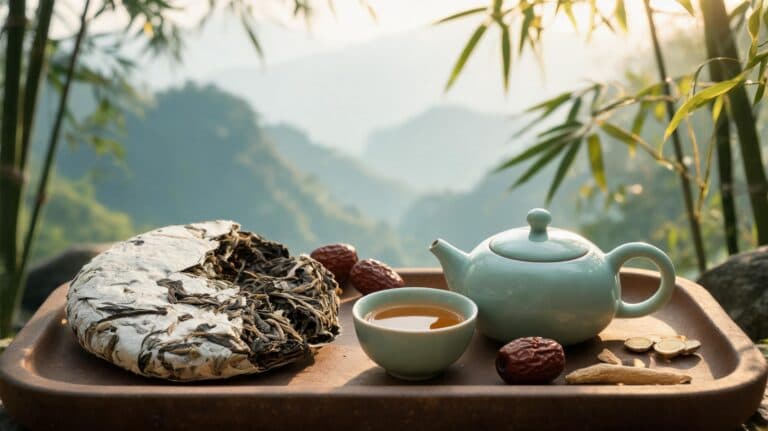
The first time I tried a 10-year-old Shoumei, I expected something mellow and maybe a little dusty. Instead, the dry leaf smelled exactly like dried jujube dates and a hint of Chinese herbal soup. The steeped tea was sweet, almost syrupy, with an aftertaste that lingered like ginseng.
That’s when I understood why aged white tea has such a quiet following. Fresh white tea—Silver Needle, Bai Mudan—is all about delicate meadowy florals. But leave it alone for a few years, and it morphs into something completely different. I want to walk you through why that happens, especially with Shoumei and Bai Mudan.
What Happens to White Tea As It Ages?
Aged white tea transforms from a fresh, lightly sweet brew into a dark, date-and-herb infused liquor through years of slow oxidation and enzymatic conversion. Unlike green tea, which is fired to stop oxidation, white tea is only wilted and dried. Active enzymes inside the leaf keep working. Over time, polyphenols oxidize into theaflavins and thearubigins—similar to what happens in black tea, but much slower—while complex polysaccharides break down into simple sugars.
A 2017 study in the Journal of Food Science found that after 5 years of aging, white tea’s catechin content dropped by over 40%, while its soluble sugar content increased by about 15%. That sugar boost is the backbone of the date-like sweetness you taste. Shoumei and Bai Mudan, with their larger leaves and occasional stems, simply have more pectin and polysaccharide material to convert. The transformation accelerates after the third year, and by year seven, you’re drinking something that barely resembles the original tea.
Why Do Aged Shoumei and Bai Mudan Develop Medicinal Notes?
Shoumei and Bai Mudan pick up medicinal, root-like scents because their larger, older leaves contain more terpenes and aromatic precursors that oxidize into compounds similar to dried Chinese herbs. Shoumei comes from more mature leaves, often with a higher proportion of stems. Stems are packed with lignins and terpenes that over time produce volatile notes like camphor, longifolene, and cedrol—aromas that read as medicinal or pharmacy-like. Bai Mudan’s bud-first structure adds a floral layer that slowly shifts toward dried chrysanthemum and licorice root.
I once opened a sealed bag of 2008 Shoumei, and the aroma was so intensely reminiscent of dang gui (Chinese angelica root) that I checked the tea twice for contamination. It was just the tea doing its thing. That deep, rooty quality doesn’t appear in Silver Needle, which stays sweeter and more fruit-driven. Shoumei goes straight for the medicine cabinet.
How Should You Store Aged White Tea to Get These Flavors?
Store aged white tea in an airtight container at room temperature, away from light, strong odors, and humidity extremes above 70% to encourage slow, clean aging. I keep mine at 20–25°C (68–77°F) with humidity around 55–60%. Any drier and the aging nearly stops; any wetter and you risk mold. Some collectors in Hong Kong deliberately age white tea at 70% humidity to speed up the medicinal notes, but for home storage, a sealed ceramic jar or a mylar bag with a 62% Boveda pack works perfectly.
Give it time. You’ll notice a faint date sweetness after 2–3 years. The medicinal edge typically arrives around year five or six. I’ve stored Bai Mudan that smelled of honeysuckle in year one, turned to dried pear in year four, and finally gave me that unmistakable Chinese-medicine-shop lift by year seven.
How Do You Brew Aged White Tea to Bring Out Dates and Medicine?
Use water right off the boil—around 95°C (203°F)—and longer steeps. For western brewing, 3 grams in 250ml for 3 minutes. For a gongfu session, pack 5 grams into a 100ml gaiwan, give a quick rinse, then start with a 30-second steep. Hotter water pulls out the heavier sugars and terpenes that create the syrupy body and medicinal finish. Low temperatures leave the tea thin and disappointingly quiet.
I find that by the fourth infusion, a well-aged Shoumei turns the color of old mahogany and tastes like warm honey-dipped dates with a cooling menthol-like aftertaste. Throw a few extra seconds on each steep and watch the liquor shift from amber to near-coffee darkness. Some old tea heads even boil an aged Shoumei in a clay pot for five minutes to extract every last drop of that date-syrup texture.
Is Aged White Tea Worth the Price?
Aged white tea prices range widely, but a decent 5-year Shoumei can be found for $30–40 per 100 grams. A well-stored 10-year Bai Mudan might run $80–120 for the same amount. That’s not cheap, but the experience is so distinct that many drinkers find it a bargain compared to aged pu-erh. You’re paying for the time, the careful storage, and a flavor profile you simply cannot mimic with a fresh tea.
At Hou Tea, I’ve come across a 2011 Shoumei with remarkable date clarity at a fair price—exactly the kind of tea that makes you stop and think, “How is this from leaves?”
Drinking aged white tea is like tasting time. It took years for those green leaves to turn into something that reminds me of my grandmother’s Chinese medicine cabinet. And somehow, inexplicably, it’s delicious.
Not sure if aged white tea suits your taste? Take our Five Elements quiz or ask our AI Tea Doctor—it’s a 30-second chat that points you toward teas you’ll actually enjoy.