6 Types of Chinese Tea, Explained Simply
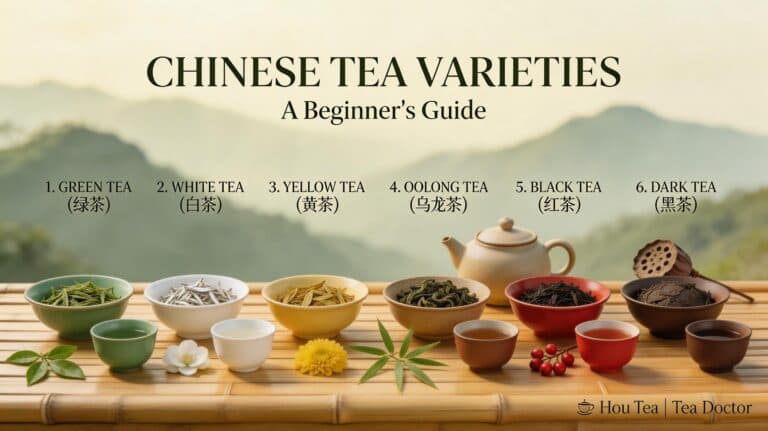
A tea shelf can teach you a lot
The first time I lined up six Chinese teas side by side, the differences were obvious before I even tasted them. One smelled like fresh cut grass. Another was soft and milky. One looked almost black in the cup, yet tasted surprisingly sweet. That was the day I stopped thinking of tea as one category.
These types of chinese tea are usually grouped by how they’re processed, not by the plant itself. That part matters. Most of them come from the same tea plant, Camellia sinensis, but heat, oxidation, and aging send them in very different directions.
I think that’s why tea gets so interesting so fast. You can drink six cups and still feel like you’ve only opened one door.
The six main types of Chinese tea
In China, tea is commonly grouped into six families: green, white, yellow, oolong, black, and dark tea. You’ll also hear people call black tea “red tea” in China, which can be confusing at first. I still catch myself doing a double take when someone says hong cha.
These are the types of chinese tea I reach for when I want to show someone how broad Chinese tea can be. They are very different from one another, and that’s the fun part.
Green tea
Green tea is the least oxidized of the bunch, which is why it tastes fresh and lively. Good ones can smell like sweet peas, steamed spinach, or chestnut skin. Longjing, or Dragon Well, is the classic example. It often has a nutty, bean-like sweetness and a flat, silky leaf shape that’s easy to recognize once you’ve seen it a few times.
Brew it around 75 to 85°C for 1 to 2 minutes. If the water is boiling, the tea can turn sharp and a little bitter. I like green tea in a glass cup because you can watch the leaves move. It feels calm in a way that matches the tea.
White tea
White tea is lightly processed, usually just withering and drying. That sounds simple because it is simple. The taste can be gentle, almost airy, with notes of hay, melon rind, honey, or dried flowers. Bai Mudan is a nice starting point. Silver needle is cleaner and more delicate, and yes, a bit pricier.
Use 80 to 90°C water and steep for 2 to 4 minutes. White tea is forgiving, but a longer steep brings out more body. The downside is that some white teas can feel too soft if you want something punchy. I don’t think that’s a flaw. It’s just a mood.
Yellow tea
Yellow tea is the rare one. It goes through a slow “sealing yellow” step that softens the grassy edge you find in green tea. The result is gentler, with notes of sweet corn, cooked chestnut, and light orchid. Junshan Yinzhen is the famous name here, though it’s not the easiest tea to find.
I usually brew yellow tea around 80 to 85°C for 2 to 3 minutes. It sits between green and white in flavor, but not in a boring middle-of-the-road way. More like a hush after a bright note.
Oolong tea
Oolong is where a lot of tea drinkers start getting obsessed. It can be lightly oxidized and floral, or heavily roasted and deep. Tieguanyin may lean toward orchid and cream, while Wuyi rock oolong can taste like roasted chestnuts, cocoa, and mineral smoke. The range is huge.
For brewing, I prefer 90 to 95°C water and short steeps, maybe 20 to 40 seconds if you’re doing gongfu style. Western style works too, around 2 to 3 minutes. Oolong is one of the types of chinese tea that changes most from steep to steep, and I love that. The first cup is rarely the whole story.
Black tea
Chinese black tea, or red tea, is fully oxidized and usually smoother than people expect. Dian Hong from Yunnan often tastes like honey, cocoa, malt, and sometimes a soft peppery note. Keemun can bring dried plum, wood, and a faint wine-like edge. I reach for black tea when I want something steady and warm.
Brew it at 90 to 100°C for 2 to 4 minutes. If you like milk in tea, some Chinese black teas can handle it, though I usually drink them plain first. A decent everyday black tea often costs around $10 to $25 for 100 grams, while finer loose-leaf versions can go much higher.
Dark tea
Dark tea, most famously pu-erh, is post-fermented. That means microbes and time shape the flavor after the tea has already been made. Raw pu-erh can feel bright, bitter, and floral when young. Ripe pu-erh is earthier, with notes of damp wood, cocoa, mushrooms, and dried dates.
Use boiling water and short steeps. Start with 10 to 20 seconds in gongfu style, or 2 to 4 minutes in a mug if that’s easier. Dark tea is one of those types of chinese tea that people either click with right away or need time to understand. I was slow to love it. Now I keep a cake on hand almost all year.
How to choose the right one
If you want something fresh and easy, start with green tea. If you like soft, gentle cups, try white tea. If you want structure and aroma, oolong is probably the most fun category to explore. Black tea is the safest choice for comfort. Dark tea is for people who enjoy a little depth and don’t mind a learning curve.
A practical note: these teas can vary a lot in price. You can find perfectly drinkable loose-leaf tea for under $15, and you can also spend $50 or more on a small amount of high-grade tea. Both can be worth it. The expensive one is not always the better daily drink.
My quick brewing rules
- Green tea: 75 to 85°C, 1 to 2 minutes
- White tea: 80 to 90°C, 2 to 4 minutes
- Yellow tea: 80 to 85°C, 2 to 3 minutes
- Oolong tea: 90 to 95°C, 20 to 40 seconds gongfu, or 2 to 3 minutes western style
- Black tea: 90 to 100°C, 2 to 4 minutes
- Dark tea: boiling water, 10 to 20 seconds gongfu, or 2 to 4 minutes in a mug
Those are starting points, not laws. Leaf size, age, and your own taste change the picture a lot.
A simple way to remember them
Green is fresh. White is soft. Yellow is mellow. Oolong is the shape-shifter. Black is warm and steady. Dark is earthy and patient.
That’s the version I wish someone had given me early on. It makes the types of chinese tea easier to hold in your head, and easier to choose from when you’re standing in front of a shelf wondering where to begin.
If you want a more personal starting point, you can ask our AI Tea Doctor for a pick based on your taste, or browse Hou Tea’s teas and compare a few side by side. I still think the best way to learn is to brew two very different teas on the same afternoon and see which cup you keep reaching for.